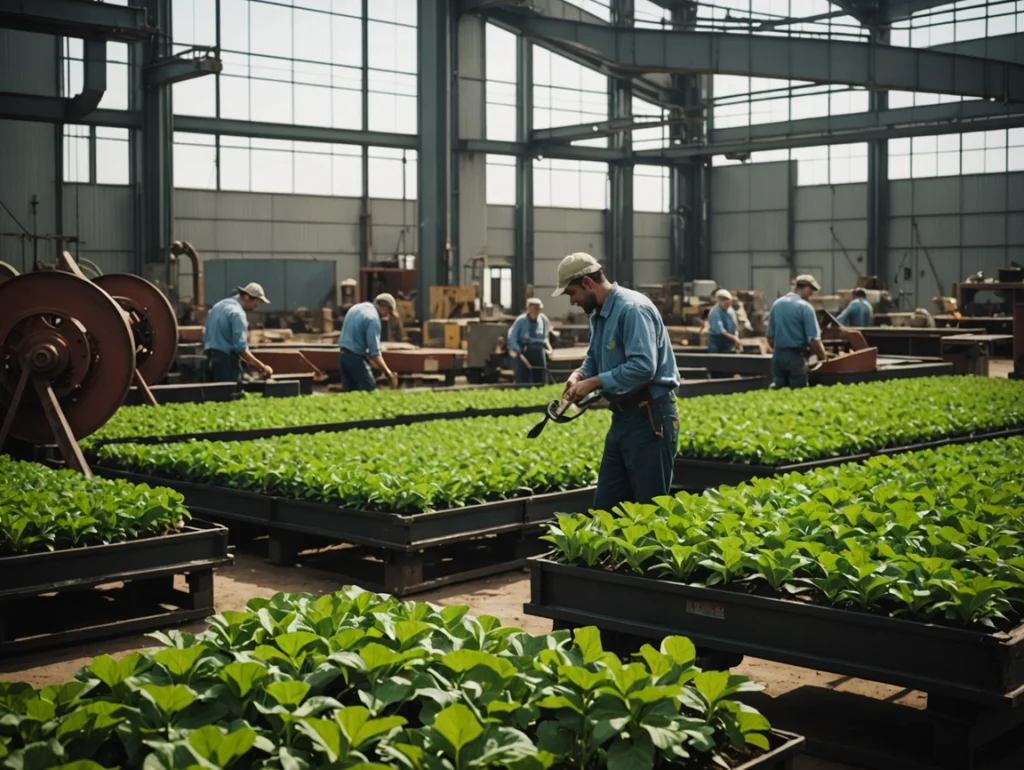
From Soil to Success: Supporting Farmers with Premium Hemp Products.
From Soil to Success: Supporting Farmers with Premium Hemp Products.
Every day, millions of traditional plastic pallets and bulk containers move through American warehouses, distribution centers, and manufacturing facilities. Most come from overseas. Nearly all contribute to a growing environmental crisis. And few support the farmers and communities that form the backbone of our economy.
But what if industrial materials could do more than just move products from point A to point B? What if they could actively capture carbon, support American agriculture, and help companies meet genuine sustainability targets, not just marketing talking points?
That’s the question driving EcoTrust’s approach to industrial materials. And the answer is reshaping how forward-thinking companies think about their supply chains.
EcoTrust’s foundation rests on a simple but powerful premise: American farmers grow some of the most sustainable materials on earth, yet our industrial supply chains largely ignore them. Hemp, in particular, represents an untapped resource with extraordinary potential.
Unlike traditional plastics derived from petroleum, hemp-based materials come from rapidly renewable crops that actually improve soil health while growing. These plants sequester carbon dioxide from the atmosphere, creating a net environmental benefit before they’re even harvested. By incorporating hemp and other biobased materials into industrial products, EcoTrust transforms agriculture from a carbon source into a carbon solution.
This approach does more than reduce environmental impact, it creates economic opportunities for American farming communities struggling with commodity price pressures and limited crop diversification options. Every EcoTrust product represents a direct investment in domestic agriculture and rural economies.
EcoTrust Pallets demonstrate how industrial materials can serve multiple purposes simultaneously. Constructed from 100% biobased and recycled materials, these pallets match or exceed the durability standards of traditional plastic alternatives while delivering genuine environmental benefits.
The revolutionary aspect lies in their integrated CCUS (carbon capture, utilization, and storage) technology. Traditional carbon capture approaches typically involve capturing emissions and burying them underground, an expensive process that essentially kicks the problem down the road. EcoTrust’s technology takes a fundamentally different approach by repurposing captured carbon into the pallet structure itself.
This means every pallet actively removes carbon from the industrial cycle and locks it into useful products. The carbon doesn’t get released back into the atmosphere; it becomes part of the supply chain infrastructure. Companies using these pallets aren’t just reducing their carbon footprint, they’re building it directly into their operations in a way that supports circular economy principles.
For operations managers, the practical benefits are equally compelling. These pallets withstand the demanding conditions of industrial environments, from heavy loads to rough handling, while maintaining structural integrity through multiple use cycles. They resist moisture, don’t splinter like wood, and maintain consistent dimensions that automated systems require. The durability means fewer replacements, lower long-term costs, and reduced operational disruptions from pallet failures.
Material handling presents another critical opportunity for sustainable innovation. EcoTrust’s Flexible Intermediate Bulk Containers (FIBCs) bring the same environmental consciousness to bulk material transport and storage.
These custom-designed bulk bags handle dry, granular, and flowable materials across diverse North American industries, from agriculture and food processing to chemicals and construction materials. The hemp-based and biodegradable construction doesn’t compromise on the performance characteristics that operations depend on.
Superior strength ensures these bags can handle heavy loads and rough handling throughout shipping and storage cycles. The materials resist tearing and puncturing that can cause costly spillage and product loss. Customization options allow precise matching to specific material characteristics and handling requirements, from flow control features to size specifications that maximize storage density.
The practical advantages extend beyond basic containment. These bags maximize warehouse space utilization through efficient stacking and storage configurations. They eliminate the spillage problems that create waste, safety hazards, and cleanup costs. Flow control features improve discharge efficiency during material transfer operations. And because they’re designed for specific applications, they often outperform generic alternatives in real-world conditions.