From Soil to Success: Supporting Farmers with Premium Hemp Products.
From Soil to Success: Supporting Farmers with Premium Hemp Products.
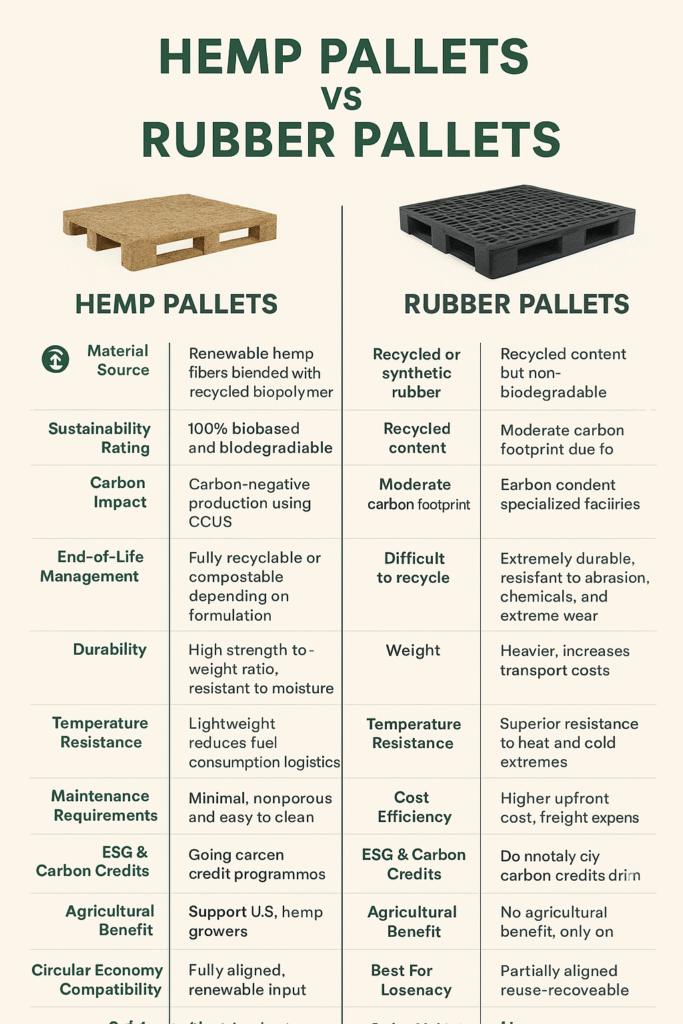
In the evolving landscape of logistics and materials management, businesses are under increasing pressure to adopt environmentally responsible pallet solutions. Two emerging alternatives to traditional wooden and plastic pallets are Hemp Pallets and Rubber Pallets. While both contribute to reducing waste and supporting sustainability goals, their underlying materials, production processes, and long-term performance differ significantly.
Hemp Pallets, such as those produced under EcoTrust™ technology, are crafted from biobased hemp fibers combined with recycled polymers, offering a fully biodegradable or recyclable structure. These pallets directly support American hemp farmers while reducing reliance on petroleum-based plastics. Hemp naturally sequesters carbon during its growth, and when used in pallet production, it contributes to lower lifecycle emissions.
By contrast, Rubber Pallets—typically manufactured from recycled tires or synthetic rubber—divert waste from landfills but retain a higher carbon footprint due to the energy-intensive vulcanization and molding process. Rubber pallets are durable and nonporous but non-biodegradable, making end-of-life disposal challenging without specialized recycling facilities.
Hemp pallets provide comparable strength-to-weight ratios to plastic or wooden pallets, with lightweight handling, moisture resistance, and shock absorption. They also integrate CCUS (Carbon Capture, Utilization, and Storage) technology, repurposing carbon rather than burying it—making them a carbon-negative solution in some configurations.
Rubber pallets are highly resistant to impact and chemical exposure, ideal for heavy-duty industrial applications. However, they can become brittle over time in extreme temperature conditions and are often more expensive to produce and transport due to their weight.
For businesses advancing Environmental, Social, and Governance (ESG) objectives, hemp pallets represent a clear advantage. They are renewable, lightweight, and carbon-accountable, allowing companies to earn carbon credits while supporting domestic agriculture. Rubber pallets, while reusable, often fall short in carbon reporting frameworks because they rely on legacy tire materials and complex recycling logistics.
Both Hemp Pallets and Rubber Pallets offer tangible environmental benefits compared to traditional options. However, Hemp Pallets provide a more holistic, regenerative, and circular economy solution, aligning with modern corporate sustainability strategies and next-generation ESG compliance standards.
Businesses investing in hemp-based logistics materials not only reduce their carbon footprint but also support American innovation, farmers, and green manufacturing—building a resilient and sustainable future for global supply chains.